
TecC 43 - Making Work Art, Making Art Work, Engineering Excellence
On craftsmanship that funneled knowledge, fueled innovation, and fostered genius

What is it that makes genius? How much of it is in the persona of an individual and how much of it comes from, what I’ve called, institutional technologies? How does it organize and amplify knowledge and skill? How does that relate to innovation? Let’s start unpacking this today.
But first let’s see what our fictional friends are up to.
Irene and Brenda walk in one day going, guys guys, guess what we’ll be having our stall at the town market next week - for the Grand Annual Market week! Steve and Bryan look up somewhat confused, Iris the cat stops her mouse-chase and Bruno the dog pauses his tail-wagging.
Steve is first to respond, wait how did you even get a spot in there, it’s indeed highly coveted and Bryan adding, we’re not even professional specialists at anything of relevance? Brenda is like, there was a free opening slot and it was too tempting to resist, Irene adding the detail that had paid out a deposit using one of their savings pot.
There’s a bit of a shockwave, Steve and Bryan eventually going: hold up, that deposit is like a full month of our collective income!! All that’s lost if we don’t make it! And what exactly are we gonna make to sell there?
Irene, trying to look unfazed, well, the artisanal sort of stuff you know, jams, confectionaries, all the good stuff in the spirit of the season. Brenda trying to look reassuring, yea, guys we’re not experts but we can still figure it out right, I mean...
In any case, the die is cast, or more accurately the deposit is made, so better get cooking. They go on a grand groceries tour, get a bunch of stuff and it’s kickoff time!
They start prepping the stuff, readying the dishes and eventually get to the preparation proper. But things are already starting to go downhill.
Irene going, no this is not clean or tidy, look you’re all making a mess. (Think Monica from Friends!)
Steve is frustrated too, come on that’s not how you chop these up, this is not the way to prep it, where is the mise en place. (He’s probably watched too many French cuisine shows!)
With Bryan chiming in, exactly, how can we prepare it properly without the ingredients laid out in order. (Or is it Bryan who’s binged on those cooking shows? Remember “Man about the House”?)
Brenda then interrupts, no guys, that’s not what matters, it’s the end result, we should have it right quantities, otherwise how can we package it properly, we should start with the end in mind (She’s probably a fan of Stephen Covey!)
So they go on bickering like this a couple of days. And before they know, it’s Friday. And they’d need to stock up the stall on Monday for the festival starting the next day! There’s not much time left and they’ve made no tangible progress at all. Something must be done, even Bruno and Iris seem worried now (although that could be for other reasons, we’ll never know.)
So they’re like, ok let’s pause, we can’t go on like this. So they sit down to discuss. They’re each complaining about the incessant focus by the other three on other tasks. No, you’re so uptight about the cleanliness, no you’re so worked up about the quantities, and so on, you get the picture. And then realization dawns.
Right, folks, look we’re all particular about one aspect of this, and that’s because we’re, relative to the others, better at that aspect. So we better set up a process and outline specific responsibilities to each of us. So Irene is into cleanliness, gets the washing mandate. Steve is methodical, gets the prepping mandate. Bryan, looks like the cooking connoisseur - so gets to be the cook. And Brenda will handle the quantities - the packaging and corresponding branding etc.
The camera now shifts to the the “Bruno and Iris Condiments” stall on Tuesday morning. A fully stocked stall with four big smiles, a furious salivating tailwag and a nonchalant feline “I could’ve done it much better all myself” eyeroll!
The Seeds of the Rebirth
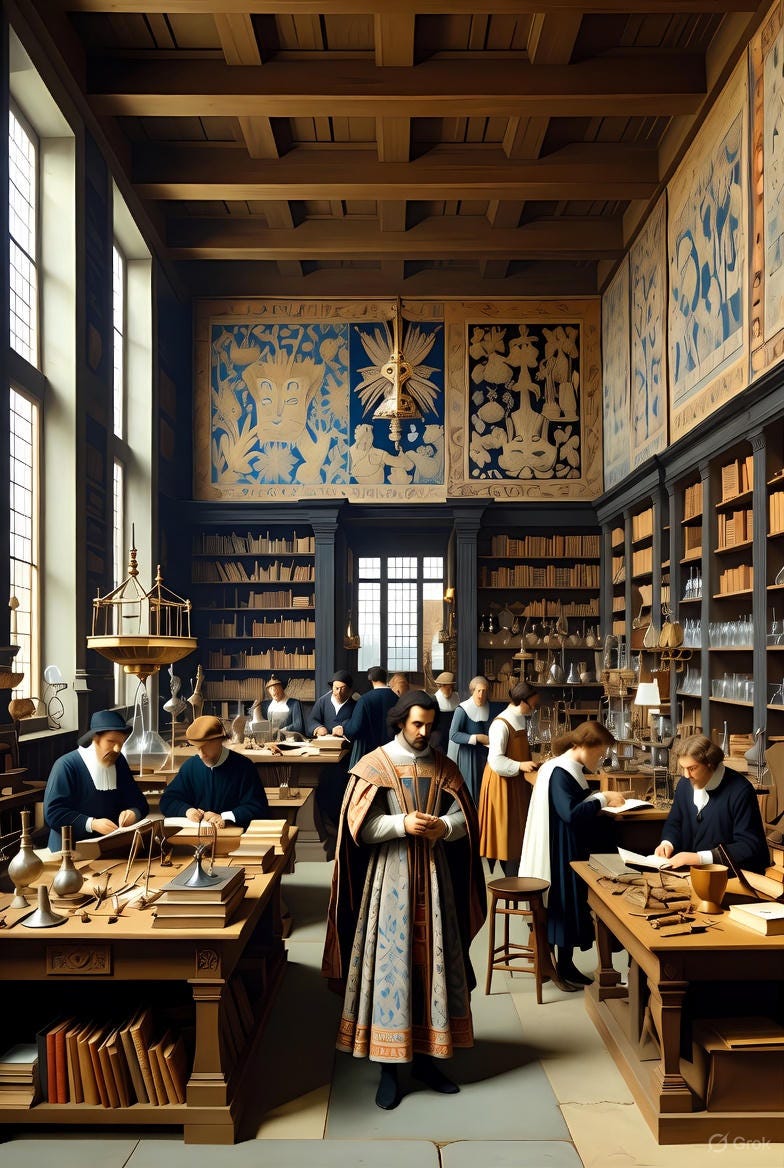
Signore e Signori, welcome to the Bottega! That premier institution that fulfilled the functions I’ve hinted in this article’s title and subtitle, that key marvel that underpinned the explosive growth in ingenuity and productivity, and genius, in what we usually call The Renaissance!
The Bottega refers to this particular type of workshop, and the practices that emerged therein in 1400s Italy (the word itself simply means “shop” or “store” in Italian, but has a broader meaning for us in the current context.)
In line with the Moveable Type Printing Press which I covered in the previous episode this institution can be seen as another step signaling the decisive break from the dingy past of the middle ages and entering the Early Modern Era, certainly of entering the Renaissance, specifically the Italian Renaissance. (The Italian word for this idea, meaning “rebirth” is rinascimento, rinascità, the form ‘renaissance’ being the French version, an alternative English form being ‘renascence’.)
But before we get to why this was such a decisive break from the past, and propelled society into modernity, let’s see how it functioned.
Lean Hierarchy, Mean Harmony
Let’s start with the organizational structure, specifically the hierarchy. There were essentially three stages in the lineup of a bottega.
You started off life as a garzone - an apprentice. This was when you had to be willing to do any and all types of chores of relevance to the workshop - right from say sweeping the floor. You lodged in the same building as the bottega, and that was largely your life.
In a few years’ time, you graduated to a compagno - an assistant or a journeyman. This was of course even more serious stuff, by this time you’d acquired enough skill to take on major portions of the project by yourself - though still largely in an atmosphere of teamwork. With this promotion, you got a proper salary and possibly other perks.
And finally, at the top, was the maestro. Now this word doesn’t need translating! As the master of the bottega, of course he had control, visibility and ultimate responsibility over all the functions of the workshop - where the buck stopped. The cursus honorum of attaining maestrohood was for a journeyman to create his own masterpiece - yes, literally, a piece of work that signalled you were ready to take the top spot, perhaps by setting up a bottega of your own.
But hierarchy is only part of the story here. And the stages of progression1 did each add value to the overall output. The apprentice did do important work despite some of it being menial (Picture this scene in our own times: the final interview question “AI can do all this, what can you do that AI can’t, why should we hire you?” At least the apprentice of yore could calmly reply “I can sweep the floor”!)
Not Just a Pretty Face
Before discussing anything else, let’s look at what people did in these bottegas.
Our image of the Italian Renaissance is one of pretty pictures, and perhaps some finely sculpted statues at most. Yes, all such work took place in these bottegas, but it was much more than that - the disciplines and projects covered here spanned hydraulics, fortifications and other constructions, clocks, canal systems, metallurgy, chemistry and included other devices and instruments.
Even the activities of churning out those exquisite paintings and sculptures were in fact works of science and engineering as much as pure art. (They were in fact art in the much broader definition of the term I’ve discussed in my foundational Episode - ‘art’ and ‘artifice’ meaning ‘skill’ and thus analogous to the Greek ‘tekhne’, which gives us the word ‘technology’.)
But here’s the crux of the matter. Each team-member had a wide range of responsibilities, and it was interdisciplinary. You were, say, learning to sketch and paint, but you’d also learn the science of mixing pigments in the finest and precise compositions to get the perfect colors, you’d dig deep into anatomy (well, not literally, although, you could argue there was an element of that - more on this another time, I promise), you would work on the science of optics etc.
To enable all these, there were standard processes and procedures that emerged, such as drawing collections and recipe books. Connected to this was the emergence of extensive documentation of processes and procedures, perhaps a first to such degree of meticulous recording (there still are extraordinarily copious amounts of such recordanze left behind by some practitioners still available to us today.)
Founders and Funders
Of course the question arises who funded this all. So alongside the artefactual and procedural elements, there arose a sophisticated economic network of participation of various stakeholders in the ecosystem. The main patrons were the large and powerful families such as the Medici in Florence who sought to works such as the paintings - (this was in good part a way of such dynasties signalling their status and power, but also ensuring a smooth pathway to heaven - many of their commissions being religious of nature.)
And there was also the Church, and the State (where that was different from such grand families, not always the case - again more of this in another episode), that commissioned works. It’s not hard to imagine the types of projects the Catholic Church would be interested in, while the political instutitions would have among its priorities stuff such as fortifications, canals, and other potentially large-scale projects.
Lastly, and I’ll get into more detail of this in the aforehinted episode on the Italian city-states and dynastic families, Italy was a patchwork of such city-states each with similar but different approaches and legal systems. This was, as we saw in the previous episode, also the case more widely in Europe, especially in the German lands where Gutenberg operated, and the factors we’ve discussed in Episode 39 and Episode 41 played out.
The First Sights of Silicon
Of course, in the modern day we are quite familiar with a great many of the aspects I’ve outlined above.
We have organizational hierarchies in almost all professional settings, floor-sweeping included or not. (Actually, that’s been replaced by today’s interns having to do team-wide coffee-serving runs instead?) We have job contracts and salaries. We have procedures and manuals and training programs at every stage of career progression, and as some of us may dread to think, those performance reviews!
The funding mechanisms mentioned resemble investment instruments of our own day including venture-capital / angel investor funding. Again, the approach is essentially profit-seeking entrepreneurialism operating in a competitive market driving innovation.
Some of the extensive documentation practices even resemble our modern-day open source mechanisms, not to mention, some of them signal the emergence consciousness and application of intellectual property to their work and dealings.
And many of these bottegas were the startups of their day? This was the silicon valley of its times?
But to appreciate what a remarkable breakthrough this was back in the 1400s, we have to first look at what came before, apart from what all this led to.
Guiding Guardians or Gilded Gatekeepers?
The typical setup in the middle ages was the guilds, a concept I’ve briefly touched upon in Episode 36. In the current context, these were associations incorporated to represent specific professions, such as the Guild of Cobblers to give a example!, who took upon themselves the responsibilities of providing that particular good or service.
These guilds were primarily concerned with the protection of their members and in the uniform quality of the output by the professionals involved, such that they could decide and enforce a uniform price across the board to the detriment of no individual member of the guild. But this, what they called “quality control measure” also meant that there was no room for innovation, for if one of them came up with a better, cheaper way of producing the same thing, that would endanger the incomes of the others.
This was further buttressed by a strict segregation of the different professions into their respective guilds, prohibiting, and yes using the arm of the law, a member of one guild trespassing the activities of another, leaving no opportunity for the cross-pollination of ideas. (I hear you say, the cobbler should stick to his last?)2
In correlation to this the guilds were largely hereditary, if you’re father was in, you could get in, and even beyond that they had very high fees for membership thus imposing massive barriers to entry. In essence you could say the medieval guilds were monopolist cartels, nepotistic and exclusionary special-interest groups.
The Genie’s out of the Bottega
In contrast to much of this, the bottega system was hierarchical yet collaborative. Even the bottega system of hierarchy was in itself different from the guild one - you needed enough expertise to go up the next rung of the ladder, that much we may accept as common sense, but importantly that career growth was based on a standard and upwardly-mobile merit-based procedure. Unlike with guilds, anyone could seek to join a bottega, and if you did well, you’d go up the ranks. There were formal contracts and legally binding stipulations laid out to ensure this, even for the lowest rung, who despite having to start low, knew of the path ahead.
The approach to work in the bottegas was both theory and practice, in contrast to a more siloed approach previously. Similarly, they managed to strike a balance between developing in-house proprietary knowledge (buttressed by IP protection instruments) and having a pool of, as I said, open-source knowledge that was widely shared in the wider community. The corresponding propensity for documentation this demonstrated meant there was replication instead of duplication.
The overall bottega system offered entrepreneurial autonomy but within broad regulatory frameworks and functioning economic and legal systems of a free-market capitalist system (not perfect, these things are probably never are, but at the very least compared to what came before.) And this functioned across the myriad polities of the Italian city-states in the first instance, and to a fair extent further afield in Western Europe, offering a fertile soil for competition and collaboration.
And, in line with what we saw with our fictional friends, there was division of labor, there was a certain amount of specialization and responsibility. But here’s the kicker, at the same time, there was also interdisciplinary cross-pollination and a significant overlap of remits, as I hinted above. This was indeed the fertile ground that enabled the emergence of the Renaissance Man - a multifaceted, cross-disciplinary, skilled polymath, cognizant of and conversant in a wide variety of domains, in the sciences as much as the arts. (And yes, rest assured I’ll get to that most representative and quintessential of such a Renaissance Man with a deep dive or three - you have the logo of my Substack to vouch for it!)
In our journey here of studying innovation and progress, and seeking to learn lessons from it, we have to pause here to ask the question, just as I did in Episode 23 discussing the genius of the Ancient Greeks
what explains these extraordinary developments?
Compared to developments in my Iron-Age phases on the Classical Era (20-30) and the Middle Ages (30-40), and much more so to the Bronze Age (12-20) one, things start to heat up now. The events that come of relevance at this stage on our journey start to move more rapidly and a lot more in parallel to others, and are of even greater relevance to us, as I trust I’ve demonstrated in the parallels drawn to our own day in the previous section.
What essentially is the renaissance? What rebirth took place? Why are we calling this the early modern?
There will be a lot of exploring to do as I intend to within this phase over at least two decades of articles. We’re shifting gears, going up a notch, pressing the pedal harder. Watch this space.
Article written by Ash Stuart
Images, voice narration and some footnotes generated by AI
Further Reading & Reference
Brotton, Jerry. (2006). The Renaissance: A Very Short Introduction. Oxford University Press. ISBN 978-0192801630.
Brotton, Jerry. (2002). The Renaissance Bazaar. Oxford University Press. ISBN 978-0192802651.
Jardine, Lisa; Brotton. (2000). Global Interests: Renaissance Art between East and West. Reaktion Books. ISBN 978-1861891662.
Ruggiero, Guido. (2015). The Renaissance in Italy: A Social and Cultural History of the Rinascimento. Cambridge University Press. ISBN 978-1107032545.
Nevola, Fabrizio. (2020). Street Life in Renaissance Italy. Yale University Press. ISBN 978-0300251463.
Galluzzi, Paolo. (2020). The Italian Renaissance of Machines. Harvard University Press. ISBN 978-0674984394.
Broecke, Lara. (2015). Cennino Cennini’s Il Libro dell’Arte: A new English language translation and commentary and Italian transcription. Archetype Books. ISBN 978-1909492288.
Cennini, Cennino; Frezzato. (2003). Il libro dell’arte. Neri Pozza. ISBN 978-8873059103.
Formal contracts governed apprenticeships, specifying terms, compensation, and training obligations. Michelangelo’s 1488 contract with Ghirlandaio, for instance, stipulated a three-year term at 24 florins annually. Progression followed observable stages: initial apprentices performed manual preparation such as pigment grinding and panel preparation; intermediate apprentices executed copying exercises and worked on minor decorative elements; advanced apprentices contributed to central compositions under direct supervision. The masterpiece submission was judged by the relevant certifying organization, which had authority to approve or reject it. Requirements varied by location: Venice specified a minimum of 2 years to reach journeyman status, Padua required 3 years, while Antwerp’s full pathway to master could take approximately 11 years.
The word “ultracrepidarian” — meaning one who opines beyond their expertise — traces to this very idea of guild-enforced boundaries. It derives from the Latin ultra crepidam, “beyond the sole.” The story, recorded by Pliny the Elder, goes that the Ancient Greek painter Apelles accepted a cobbler’s critique of how he’d rendered a sandal in one of his paintings, but when the cobbler proceeded to criticize the leg as well, Apelles retorted “ne sutor ultra crepidam” — “let the cobbler not go beyond the sandal.”
So then the question about why this developed first in Italy... Do you think it has to do with more extensive trading links with the Middle and Far East and Africa where other systems of manufacture existed?